

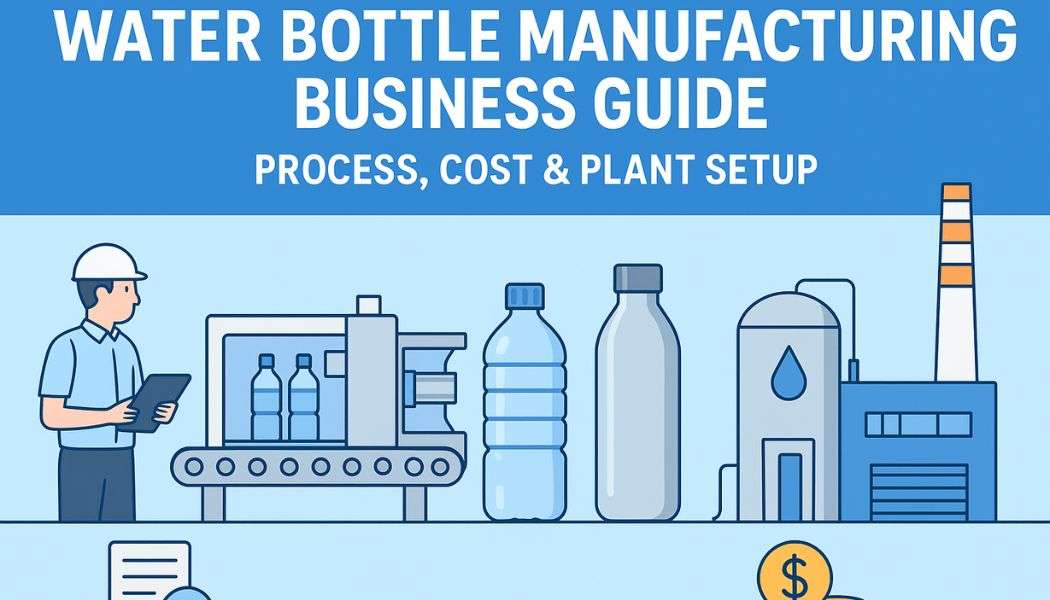
Water Bottle Manufacturing Business Guide | Process, Cost & Plant Setup
August 28, 2025
Complete Guide to Water Bottle Manufacturing: Process, Costs, Trends & Profitability
Water bottles are an inevitable component of contemporary life. Carrying a water bottle has become second nature, whether we are commuting to work, going to school, exercising at the gym, or traveling. Safety, convenience, and reusability of water bottles remain a popular demand, which offers prospects to water bottle manufacturing businessmen. As health consciousness and preference towards packaged water increases, the business has emerged as one of the most promising businesses in recent years.The process of manufacturing water bottles is focused not only on the production of containers but also on technology, design, safety requirements, and sustainability. This guide will discuss all the things starting with the way the plastic water bottle manufacturing is done through to how it will cost to establish a water bottle manufacturing plant and future trends in the industry.
Types of Water Bottles in the Market
Whenever we imagine water bottles, the first image that runs in our mind is a bottle that is made of plastic. Nevertheless, the market is much more varied and has a variety of options to address the needs and preferences.Most of them are plastic bottles, mostly because the bottles are cheap, weightless, and readily accessible. Glass bottles, in their turn, are regarded as high-end choices since they are chemical-free and safe yet can be fragile. Another popular type is stainless steel bottles, which are durable, reusable, and eco-friendly, which is why they are a good choice for those who want some. Environmentally friendly consumers have recently been attracted to biodegradable or bamboo-based bottles, which have less impact on the environment.
This diversity guarantees that the water bottles could serve the interests of all, including low-end consumers and health- and environment-conscious consumers.
Plastic Water Bottle Manufacturing
Plastic bottles remain the most dominant in the market, even though there are substitutes such as glass and steel. The reason behind their dominance is that they are cheap, lightweight, and suitable for production in bulk. Businesses in the packaged drinking water industry also find plastic water bottles convenient because of the dependence on PET (Polyethylene Terephthalate) bottles.PET is very popular due to its strength, transparency, recyclability, and food safety. Another material is High-Density Polyethylene (HDPE) which is usually employed in more robust bottles that require greater stability. Nevertheless, manufacturers are equally experiencing setbacks with plastic as environmental issues are rising with the pressure being on the industry to move towards recycled and biodegradable materials.
Step-by-Step Plastic Water Bottle Manufacturing Process
Laying a plastic bottle of water is considerably more technical than it appears. It begins with the preparation of raw materials and concludes with quality control measures to make sure that it is safe and durable.- Firstly, PET granules are dried in order to eliminate moisture because any slight amount of it can influence the bottle strength. The second stage is injection molding in which these granules are melted and shaped into tiny preforms resembling test tubes. Such preforms are subsequently heated and blown out in a procedure known as blow molding in which high-pressure air is used to mold them into bottles. Lastly, bottles are subjected to rigorous quality-assured tests such as leak tests, durability tests, and food safety tests before they are packaged and distributed.
Water Bottle Manufacturing Plant Near Me
Water Bottle Manufacturing Plant Near MeIt is as easy as ever when you are searching to locate a water bottle manufacturing plant near me with the help of online directories and digital platforms. Websites such as IndiaMART, TradeIndia, and Google Maps list manufacturing plants along with customer reviews, certifications, and contact details.
The advantages of a local production plant are many. It saves money on expenses of transportation expenses, delivery is faster, and communication with the manufacturer is possible. Plants located nearer to the customers also stand in a better position to offer after-sales service, design, and large quantity supply. Before making the decision, it is also worth checking the production capacity, certifications, and the reputation of the plant as a means of ensuring quality.
Water Bottle Manufacturing Plant
The establishment of a water bottle manufacturing plant is an undertaking that has to be planned and invested in. Space is the first requirement because plants typically require 500 to 2,000 square feet of space based on the size of production. This plant must be situated in a place that is well served by road networks as well as electricity and water supply.The second important need is machinery. Injection molding machines, blow molding machines, air compressors, chillers, and labeling systems are considered essential machines. It is also essential to have a qualified labor force to run the sophisticated equipment and provide successful production. There are also quality controllers and packaging staff that are important in providing finished products.
Water Bottle Manufacturing Plant Cost
The price of establishing a water bottle manufacturing plant cost will be based on its size and location. A small-scale plant may cost between 15 to 25 lakhs, and medium-sized may cost 30 to 50 lakhs. Plants that have access to large machinery and have a greater output can easily go beyond 1 crore.A significant part of the investment is purchasing machines, and almost 60% of the expenditure is taken up. Another 20% is land and utilities, with the remaining being labor, training, and licenses. Electricity, water, raw materials, and maintenance are running costs that have to be considered in calculating the long-term investment.
Required Licenses and Certifications
There are stringent rules that guide the production of drinking water bottles in order to protect consumers. The first one is an FSSAI license, which confirms the bottles are food-grade safe. Moreover, the companies could not avoid the necessity to have pollution control board clearance since the production of plastics may impact the environment.Local trade licenses and factory permits are also compulsory, and people planning to go international should have ISO certification in their mind. Such certifications do not only create consumer confidence but enhance market credibility.
Profitability of Water Bottle Manufacturing Business
Profitability is one of the reasons why entrepreneurs are attracted to water bottle manufacturing. The bottled water business is growing at an alarming rate as a consequence of urbanization, lifestyle shift, and increased health consciousness.The profit margins of this business may be 25-40% compared to efficiency and scale. Recovery of the initial investment can be taken up in one or two years, hence profitable. The market provides manufacturers with stable growth as demand remains constant, underpinned by households, offices, retailers, and the hospitality industry.
Challenges in Water Bottle Manufacturing
Although the industry is profitable, challenges do not go without saying. Among major concerns, there is the environmental critique of plastic bottles, which has resulted in tightening governmental rules. There is also intense competition among the manufacturers in the face of the established brands occupying retail shelves.The cost of raw materials, particularly the PET granules, may vary within international markets, which directly affects the level of profitability. To overcome these problems, new entrants should concentrate on innovation, sustainability, and excellent branding.
Latest Trends in Water Bottle Manufacturing
The industry is changing according to new trends to handle the needs of consumers as well as environmental issues. Bottles that can be recycled and those that can biodegrade are growing in demand because they reduce plastic waste. Fitness enthusiasts are going crazy over smart water bottles that have hydration sensors.Another significant trend is customization. Corporates, businesses, and event planners are putting greater demands upon branded bottles featuring distinct logos and designs. These trends reflect why manufacturers should remain innovative and flexible.
Sustainability in Water Bottle Production
The industry has taken on the aspect of sustainability as a driver. Recycled PET (rPET) requires less energy and generates less waste, which manufacturers are currently moving to. Other firms are looking at biodegradable plastics and plant-based materials that will disintegrate naturally.Minimization of carbon footprints is being achieved by the use of energy-efficient machines, solar-powered plants, and eco-friendly packaging materials. Such initiatives do not only favor the environment but also attract the attention of environmentally aware consumers.
Marketing and Distribution Strategies
Half the battle is to produce the bottles; success depends on good marketing and distribution. Quite a number of businesses sell their bottles to retailers, wholesalers, and packaged water companies. Others exploit e-commerce options such as Amazon and Flipkart to access larger segments of the population.A good role model of success is a firm like Bisleri, Aquafina and Evian. Branding is also important. Products are competitively advantaged by custom printing, eye-catching design and green tags. In the long term, manufacturers that develop good distribution channels and focus on brand image can expand.
Case Study: Successful Water Bottle Manufacturers
A good role model of success is a firm like Bisleri, Aquafina and Evian. They started small-scale operations but had invested in quality, innovation, and high-scale distribution. They are household names worldwide today.These brands can teach new entrepreneurs a lot, especially the need to stay loyal to product quality, create trust, and keep up with shifting customer preferences.
Conclusion
The industry of water bottle manufacturing is not only a business process of industry but an expanding business with enormous potential. Plastic bottles are still the current order of the day, but the future will be in environmentally friendly and innovative products. Plant establishment entails investment, machinery, licenses, and planning; yet, the right strategy makes the business very lucrative. Water bottle manufacturing is one of the industries that can be considered by entrepreneurs seeking to exploit an ever-increasing demand.