

The Ocean’s Silent Guardian – A Heart-Touching Story of Courage and Compassion
November 28, 2026
The Ocean’s Silent Guardian – A Heart-Touching Story of Courage and Compassion
The sea had always been part of Meera’s life.
She grew up in a small fishing village where mornings began with the sound of waves, fishermen preparing their boats and seabirds searching for food along the shore. Her father, Raghav, had spent nearly thirty years fishing in the same waters. He knew the ocean better than anyone in the village.
But Meera saw the sea differently.
To her, it was not just a source of income. It was a living world filled with stories, mysteries and creatures that deserved protection.
One evening, while walking along the beach, she noticed something unusual near an old fishing boat.
A large sea turtle was struggling in the shallow water.
Its front flipper was tangled in a discarded fishing net, and every attempt to move pulled the net tighter.
Meera immediately ran towards it.
“Don't worry,” she whispered. “I'll help you.”
She tried to remove the net carefully, but the knots were too tight. The turtle moved its head weakly, and Meera realised that she needed help.
She ran towards the village.
A Discovery That Changed Everything
“Father! Please come quickly. There's a turtle trapped in a fishing net!”
Raghav was repairing his boat when she reached him.
“Meera, it is getting dark. We will look at it tomorrow.”
“But it may not survive until tomorrow!”
Her father looked at her worried face and finally agreed.
They returned to the beach carrying a small knife, a torch and a bucket of water. Raghav carefully examined the net and began cutting it away without touching the turtle's injured flipper.
After several minutes, the turtle was free.
But it did not immediately return to the sea.
It remained still, breathing slowly.
Meera sat beside it.
“Will it be okay, Father?”
“We have freed it from the net. But it needs proper care.”
Raghav contacted a nearby wildlife rescue volunteer whose number was displayed on a noticeboard at the village community centre.
The volunteer arrived with a small team and examined the turtle. They explained that abandoned fishing nets and other marine waste can seriously injure sea turtles.
Before leaving, one of the volunteers told Meera something she would never forget.
“Sea turtles have travelled through our oceans for millions of years. They help maintain healthy marine ecosystems, but human activities are making their survival difficult.”
That night, Meera could not sleep.
She kept thinking about how easily the turtle could have died because someone had left a fishing net behind.
The Secret Hidden Beneath the Waves
Over the next few days, Meera visited the rescue centre to check on the turtle.
The volunteers named it Tara.
Tara was recovering slowly, and Meera was delighted whenever she saw it moving around more comfortably.
During one visit, a volunteer showed her photographs of other sea turtles affected by plastic waste, fishing equipment and damaged nesting beaches.
Meera was shocked.
She had always believed that the ocean was so vast that a little rubbish could never make a difference.
Now she understood how wrong that assumption was.
She also learned that sea turtles play important roles in marine ecosystems. Different species help maintain the balance of habitats such as seagrass beds and coral reefs. Anyone interested in learning more about these remarkable creatures can explore the information shared by the World Wildlife Fund about sea turtles.
On her way home, Meera made a promise.
She would do something to protect the ocean.
Even if she had to start alone.
When the Village Refused to Listen
The following Sunday, Meera stood in the village square and asked everyone to join a beach-cleaning activity.
She had prepared a handmade poster that read:
“The Ocean Gives Us Life. Let's Not Give It Waste.”
Some children immediately agreed.
But many adults laughed.
“Meera, cleaning the beach will not change anything,” one fisherman said.
“We have more important work to do,” another added.
Even her father advised her not to expect too much.
“People will understand slowly. Don't be disappointed if they don't listen today.”
Meera felt hurt, but she refused to give up.
She began with the children.
Every evening, she gathered a small group of friends and collected plastic bottles, broken fishing lines and other rubbish from the beach. She placed separate containers near the village entrance for recyclable waste.
At first, only five children joined her.
Then ten.
Within two weeks, nearly twenty children were participating.
Their work started attracting attention.
A local shopkeeper offered gloves and collection bags. A teacher arranged a short awareness session at the village school. Even some fishermen began bringing damaged nets back to the collection point instead of leaving them near the shore.
Meera realised that change did not always begin with a powerful person or a big organisation.
Sometimes, it began with one person who refused to ignore a problem.
The Night of the Storm
One night, dark clouds covered the sky.
Strong winds shook the palm trees, and heavy rain began falling over the village. The fishermen rushed to secure their boats before the storm became worse.
Meera was standing near the window when she heard someone shouting outside.
“Help! The water is rising!”
She ran towards the beach with her father.
Near the shoreline, they noticed several pieces of abandoned fishing equipment being dragged back into the water by the waves.
Among them was a large tangled net.
Meera suddenly remembered Tara.
The rescue team had explained that discarded fishing gear could trap marine animals even when no one was using it.
“Father, we need to remove that net!”
“Meera, the waves are too strong. Stay back!”
But she could see the net moving closer to the water.
Raghav called two other fishermen, and together they used ropes to pull the equipment away from the shoreline. Meera stayed at a safe distance, guiding them with her torch.
After a difficult few minutes, they managed to secure the net.
The next morning, the village discovered that several more fishing nets and plastic containers had washed onto the beach.
Instead of complaining, the villagers gathered to clean the shore.
For the first time, Meera did not have to ask anyone to join her.
Tara's Return to the Ocean
A few weeks later, the rescue team informed Meera that Tara had recovered sufficiently to be released.
The entire village gathered near the beach.
Children held handmade signs, while the fishermen stood quietly beside their boats.
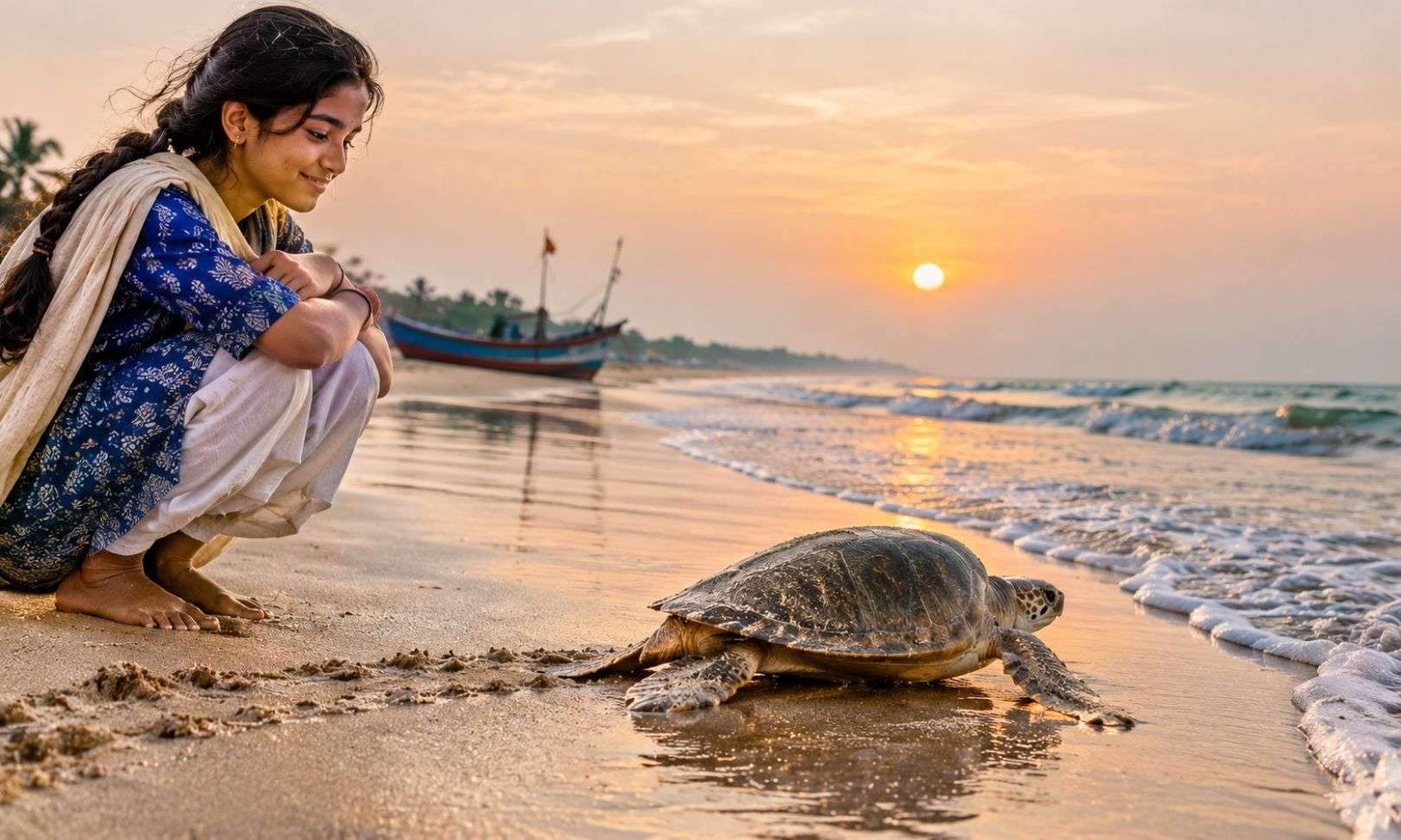
Meera knelt on the sand as the volunteers placed Tara near the water.
“Goodbye, Tara,” she whispered.
For a moment, the turtle remained still.
Then it slowly moved forward.
Its flippers pushed against the wet sand, and a small wave washed over its shell. Another wave came, carrying it further into the sea.
Meera watched until Tara disappeared beneath the water.
Her eyes filled with tears, but this time they were tears of happiness.
Raghav placed his hand on her shoulder.
“You know, Meera, I have spent my whole life taking things from the ocean. You have taught me that we must also give something back.”
She smiled.
“We don't have to save the entire ocean in one day, Father. We just have to stop making it harder for the creatures living in it.”
A New Beginning for the Village
Months passed.
The village introduced regular beach-cleaning activities. Fishermen began collecting damaged nets for safe disposal, and the school started an environmental club.
Meera's small initiative gradually became a village-wide movement.
A wooden sign was placed near the beach:
“Welcome to Our Village. We Protect the Ocean That Protects Us.”
One evening, Meera returned to the same place where she had first found Tara.
The sun was setting, painting the water in shades of orange and gold.
She looked at the endless waves and wondered where Tara might be swimming.
Perhaps it was crossing distant waters. Perhaps it was searching for food among the seagrass. Or perhaps it was simply enjoying the freedom of the open ocean.
Meera did not know.
But she knew one thing: her actions had helped create a safer place for the creatures that called the ocean home.
And that was enough.
Conclusion: Small Acts Can Create Big Changes
Meera's journey reminds us that kindness is not limited to helping people. It also means caring for animals, protecting nature and taking responsibility for the world we share.
Her story shows that courage does not always involve doing something extraordinary. Sometimes, it means speaking up when others remain silent and taking the first step when everyone else believes change is impossible.
The ocean cannot ask us for help in words. But its condition tells us when it needs our attention.
The greatest lesson is simple: We do not inherit nature only to use it. We have a responsibility to protect it for the generations that come after us.
What would you do if you found an injured sea animal on a beach? Would you stop to help?
Share your thoughts in the comments.