

Indus Water Treaty: A Strategic Resource in India-Pakistan Diplomacy
September 15, 2025
Indus Water Treaty and Use of Water as a Diplomatic Bargain
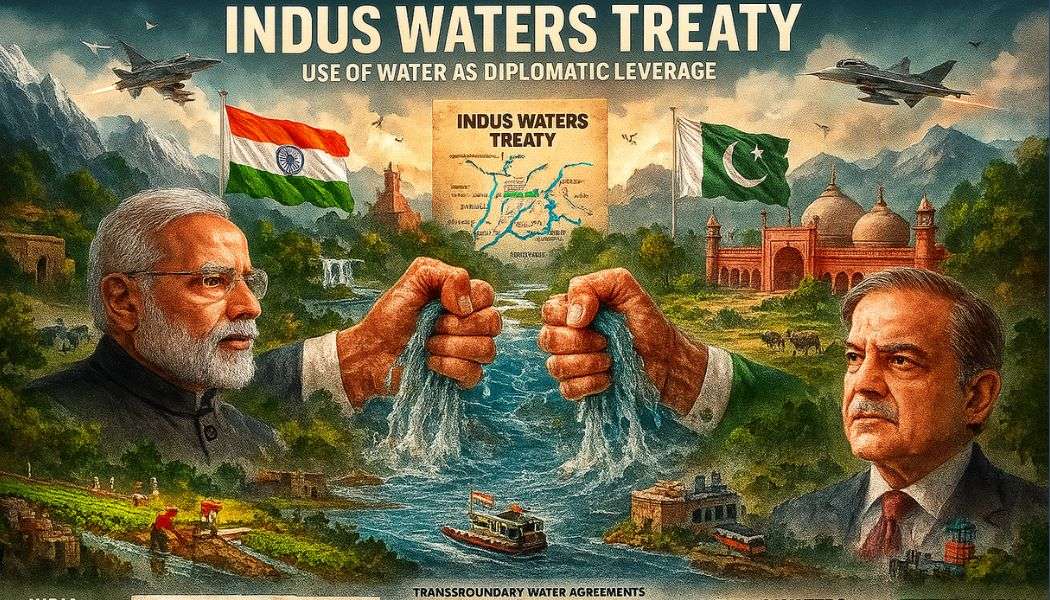
Water has never been just a resource. It is a strategic instrument for India and Pakistan a strategic instrument as well. The 1960-signed Indus Waters Treaty (IWT) still dominates the regional politics and diplomacy. As of now, though, it’s clear that water is becoming a pawn in bilateral games. This is what makes the treaty not just about water, but also survival, security, and stability in South Asia.
India-Pakistan Water Dispute
The water dispute between India and Pakistan is one of the most contentious issues between the two countries. Both depend so entirely on the Indus Basin rivers for farming, power, and even existence. India’s rivers, on the east, are controlled by India; Pakistan is dependent on those flowing to it from the west. Rising water demand, coupled with political tension, has fueled distrust.
The fight is as much technical as it is intensely political. Farmers, factory owners, and urban centers in both countries vie for limited water. Mismanagement, distrust and entrenched rivalries have made water sharing a potent symbol of national pride and weakness.
Current Water Dispute Between India and Pakistan
The current water dispute between India and Pakistan is over new hydropower projects on rivers running from India to Pakistan. Islamabad worries that those projects will reduce water flow and harm its agriculture. New Delhi contends that the projects are in conformity with treaty rules and are crucial for energy security. Pressure is further exerted by climate change, the melting of glaciers, and growing populations. These problems complicate and exacerbate the water battle.
In recent years, Pakistan has submitted a number of projects to international arbitration, alleging that treaty goals have been breached. India maintains that all such projects are within permissible uses. This tit-for-tat war of litigation has frayed relations and fostered an environment of suspicion.
Indus Waters Treaty Provisions
The Indus Waters Treaty provisions share the six rivers of the Indus Basin. India was given full rights over the eastern rivers — Ravi, Beas, and Sutlej. It provided the western rivers (Indus, Jhelum, and Chenab) to Pakistan. The pact also grants India restricted use of western rivers for farming and hydro projects while keeping the flow of water unchanged.
This old contract outpaced the wars and battles waged between India and Pakistan. It is frequently cited as one of the most successful water-sharing pacts in the world. The treaty is governed by the Permanent Indus Commission, which adjudicates disputes arising over its implementation.
The value of the Indus Waters Treaty is in its resilience under strain. Despite fighting and political enmity, the two countries have respected it. This proves that water cooperation, even between enemies, is not impossible when it comes down to the basic question of survival.
Transboundary Water Agreements
One of the notable examples of transboundary water agreements is the Indus Waters Treaty. These treaties govern the use of rivers that flow through more than one neighboring country. In many regions throughout the world, similar treaties are used to prevent conflict. Secure water agreements provide for stability, cooperation and confidence. But when there is a perception of being disadvantaged, these same treaties can be leveraged to apply pressure.
Rivers running through more than 260 rivers worldwide flow across borders. Disagreements can become conflicts without the right arrangements. The IWT is often held up as a template for other global negotiations. But its struggles also show the dangers of weaponizing common property for politics.
For India and Pakistan, water has become a strategic tool of foreign policy. They know that controlling water is synonymous with controlling agriculture, economy, and security. This situation makes the treaty’s relevance more pertinent than it has ever been.
Indus Waters Treaty Challenges
But even though the treaty has been a success, it is also beset with criticism today. Demand is on the rise with both countries’ populations expanding rapidly. Climate change is shrinking water supplies, making sharing more challenging. India has also accused Pakistan of abusing that treaty to thwart development projects. Pakistan says that India is violating treaty provisions by constructing large dams.
The main issue is drawing a crushing card later as diplomatic leverage. When tensions flare up, Indian voices are raised to question or even scrap the treaty. Pakistan, downriver from India, views it as an existential threat. Such threats demonstrate how water has become a political weapon as well as a resource.
Reality is now different, with unpredictable rain and diminished glacier water reserves, and an attention-getting warming climate. If neither country adjusts, the treaty risks becoming obsolete. Working together on new technologies and conservation methods might provide long-term answers.
Conclusion
It is the Indus Waters Treaty that continues to stand even today as a monument of South Asian diplomacy. But its future will be trust, adaptation, and dialogue. India and Pakistan need to work together for climate change, revitalize treaty processes, and encourage transparency. Water is meant to be a unifier of peace, not a means for conflict.
Only collectively can the countries find two solutions that ensure long-term water access for both. And trust will also help keep it from being just something else to blow up over. The treaty still holds out hope for peace if both sides are prepared to adhere to and reform it responsibly.