

Find Your Unique Selling Proposition (USP) in Technology
August 02, 2025
Finding Your Unique Selling Proposition (USP) in Technology
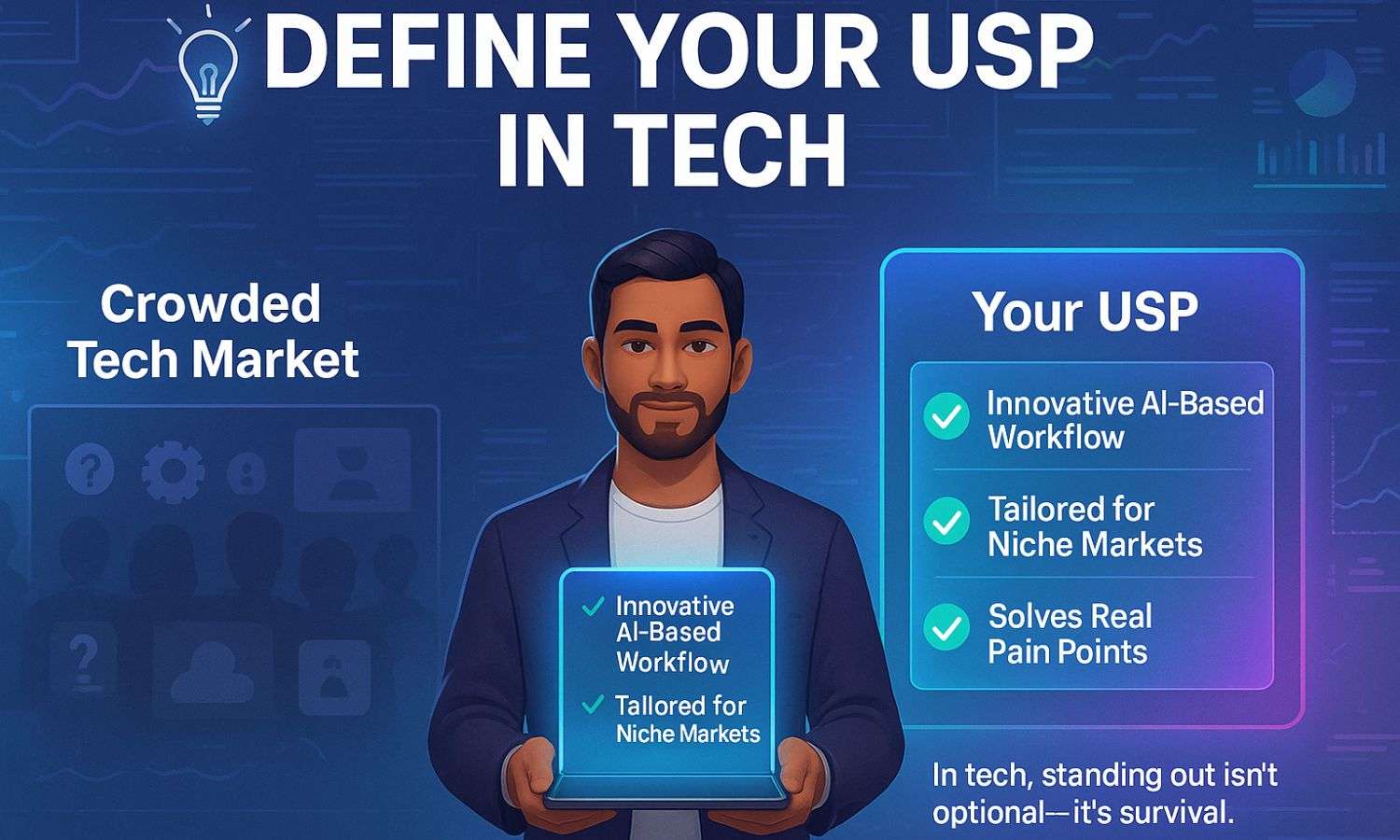
Creating a tech product is just the first step. It is equally important to have a hook. Something that attracts potential customers and leads them to think, Oh, this is a must-have. Your Unique Selling Proposition (USP) fulfills this need. Especially for tech startups, the ability to find and craft a solid USP can make the difference between being noticed and fading into obscurity. So, what is a unique selling proposition in tech, and what is the best way to define your USP in this highly competitive market? Let’s dig deeper.
A USP in the tech industry is a Unique Selling Proposition that your business or product competes with in the tech market. It is a differentiating mark that sets your product apart from the competition. It is the ideal benefit your customer would receive for making use of your product. It can be a feature, a benefit that addresses an industry problem or pain, or a desirable user interface and experience. More focus must be placed on the primary issues that your target market considers to be paramount.
Value and Importance of a USP for Tech Startups
Startups in the tech niche know that gaining a foothold is extremely challenging. A well-defined USP in the tech industry allows you to pivot successfully in a flooded market. The importance of USP for tech startups is paramount because, unlike already established firms, they cannot rely on their reputation to market their product. A clearly defined USP not only makes marketing and promotion effortless, but it also helps in gaining the trust of potential investors.
Analyze Competing Companies to Determine Your Tech USP
Developing a unique value proposition for tech startups starts with researching what others have to offer in the market. Completing a thorough analysis of competitors to find your tech USP is crucial to gaining insights and benchmarking competitor USPs to identify gaps in what is already available in the market. Competitor benchmarking for tech USP helps in evaluating the market so you can meet customer needs that have been unattended for a long time. This benchmark competitor's USPs tech approach will guide your strategy to stand out effectively.
Understanding Customer Pain Points in Technology
Identifying customer pain points in tech greatly helps in developing unique selling propositions (USP). What existing products, services, or solutions do your customers have problems with? Why do your customers feel like the services they pay for do not meet their expectations? To engage your customers, develop surveys, conduct interviews, or visit online communities where your audience spends their time. Listening to customer feedback for USP development helps you uncover problems that your product can address in a meaningful way.
Listening to customers gives you an incredible opportunity to shape the tech product to fit their needs. Gathering feedback should not be viewed as a one-off, a single effort that needs to be completed. Focus on support center tickets, product review submissions, and social media conversations surrounding the product. Listening to your customer pain points tech USP, especially in the tech industry, helps you develop meaningful and relevant USPs for your target market.
Positioning Strategies for Tech USP
As part of your marketing strategy, determining when, if, and how to position your USP is integral to the perception of your product in the market. For many SaaS companies, for example, user-friendliness, affordability, or even scalability could be leveraged as software differentiators. For hardware startups, innovation or design, as well as durability, could also take focus. It is also recommended that your positioning strategies for tech USP align with your ideal customers' preferences, whether you are focusing on positioning strategy SaaS vs hardware.
Branding and Positioning in Technology Niche
Every single part of your branding that includes your USP must also be incorporated into your website. It must be evident in your product demos so that the unique value that you provide is unmistakable. Highlighting your trademark as “innovative” or “user-friendly” is not enough. Your branding, positioning, technology niche voice, visual aids, and even interactions with customers need to be aligned with the statements you make.
Differentiation Tactics for Tech Companies
With regards to tech companies, unique and innovative methods of differentiation tactics for tech companies are sector-specific. Differentiation could result from the user experience, significant post-purchase customer satisfaction, or even through a seemingly simple but vital differentiator for technology products, which is offered by no competitor. Succeeding in innovation as a USP for tech startups, many startups focus on user-centric models that supersede simple replicability.
Building a Value Proposition Canvas for Tech
A value proposition canvas for tech firms is a tech firm's product development tool for aligning customer expectations and needs with product features. It also captures customer tasks, benefits, and their pains. With this information, you are equipped to create a value proposition canvas for tech that is both distinctive and relevant. The exercise helps you to innovate value-added features for your product.
Mapping Customer Journeys to Improve USP
Every interaction a customer has with your product before, during, and after purchasing is part of their journey. Mapping customer journeys to refine USP helps to pinpoint where your product is doing well and where it is falling short. This exercise helps improve a USP by ensuring that it is anchored on real-world user experience as opposed to conjectures and hypotheticals.
Tech USP and Target Niche Selection
The fastest way to ruin your USP is trying to appeal to everyone. Instead, target a niche where you will be regarded as the solution. It could be a user type, an industry, or a use case that is ignored by the bigger players. Use the market gap analysis in tech to find these undersized gaps and craft your niche market selection for tech USP around them.
Tech USP Ideas for SaaS Startups
For SaaS start-ups, a compelling USP may focus on automating menial work, offering a streamlined UI/UX with a dashboard, or offering predictive analytics for smarter decision-making. Some SaaS solutions differentiate themselves by serving hyper-niche verticals, offering industry-specific tailored SaaS solutions that generalist SaaS platforms cannot provide. These are some of the key tech USP ideas for SaaS startups that help them stand apart in a saturated market.
Your Innovation Should Be Clear and Attractive
Innovation often serves as the driving force behind a strong USP. Unlike other industries, with a tech USP, it is not about being the first to roll out the latest gadget—it is about serving the user with that gadget. Be it a new innovative feature that creates a strong USP like a user-facing AI-based recommendation system, low-code customization options, or other tools that allow for expansive seamless integrations, your innovation matters.
Change In Customer Trends And Expectations as USPs
Keeping up with technology trends shaping USPs such as AI, blockchain, and IoT is critical as they reinvent customer expectations over time. Incorporating such trends into your offering can help craft a futuristic USP with the aim of establishing your start-up as an industry leader and creating a competitive advantage in tech marketing.
Evaluating your Tech Positioning in the Market
It is beneficial to your business to start with testing your tech USP in the market before fully devoting yourself to the USP. Market testing can be conducted with the help of testing USP messaging with users, A/B landing page tests, small pilot program tests, or Beta user feedback collection. These testing methods help validate the tech's unique selling proposition to determine if your USP is in line with your audience and if it brings the level of engagement and conversion anticipated.
Effectiveness Measuring Techniques For Startups
Positive feedback cannot be the only measure of success. Your business can be successful if there is an increase in conversion, retention, time spent on the app, and other chosen metrics. These metrics are indicators of your business showing if the USP is underdelivering or overshooting the actual promise. Relying on USP validation techniques for tech startups ensures the USP is refined through active testing and remains impactful.
It is clear to explain your business to customers and investors with the USP, but determining it is an iterative exercise. Focus on what the customers truly need, leverage what the market is offering, and help businesses by providing something different. This is how your defining USP for software companies becomes the fuel for growth. A distinctive and strategically defined USP is vital to a successful growth strategy in a highly disruptive environment because it is what distinguishes and gives relevance to the startup. Knowing how to stand out as a tech startup is key to long-term survival and success.